NEWS FLASH: WE just learned that the long awaited "Fenton Appeal" has failed under the weight of this county's Critical Areas Ordinance and the notorious cast of bully bureaucrats at PDS. Read the Hearing Examiner's Summary of Appeal and Decision. Toward the end of the tortured story, in Section III, it explains that given the facts full justice may be found in a court of law. But otherwise "a modest amount of offsite mitigation" might do.
As for the bureaucrats testimony, the decision failed to mention that the county's "expert witnesses" had no more than one week's training, or that Ecology's most senior witness had no direct experience conducting scientific studies in the field. But they did have a manual and years of experience throwing the book at people.
Dream of justice, if you can. It looks like this crushing regulation machine will keep grinding away unchecked. Maybe the situation can be improved, but it won't happen if this ends here. As for offsite mitigation shakedowns, take heart:
As for the bureaucrats testimony, the decision failed to mention that the county's "expert witnesses" had no more than one week's training, or that Ecology's most senior witness had no direct experience conducting scientific studies in the field. But they did have a manual and years of experience throwing the book at people.
Dream of justice, if you can. It looks like this crushing regulation machine will keep grinding away unchecked. Maybe the situation can be improved, but it won't happen if this ends here. As for offsite mitigation shakedowns, take heart:

PLF Takes Property Rights Case to the Supreme Court
by Brian T. Hodges - January 23, 2013
PLF attorneys are back from Washington, D.C. after arguing a property rights case of national significance to the U.S. Supreme Court earlier this month. The case, Koontz v. St. John's River Water Management District, asks whether the Constitution protects property owners from government demands that require them to pay for unrelated public projects in order to receive permit approvals. In Koontz, a Florida land use agency demanded that Coy Koontz, Sr. pay to fix up government-owned property located miles away his property before the agency would issue any of the permits necessary for Koontz to develop his land.
by Brian T. Hodges - January 23, 2013
PLF attorneys are back from Washington, D.C. after arguing a property rights case of national significance to the U.S. Supreme Court earlier this month. The case, Koontz v. St. John's River Water Management District, asks whether the Constitution protects property owners from government demands that require them to pay for unrelated public projects in order to receive permit approvals. In Koontz, a Florida land use agency demanded that Coy Koontz, Sr. pay to fix up government-owned property located miles away his property before the agency would issue any of the permits necessary for Koontz to develop his land.
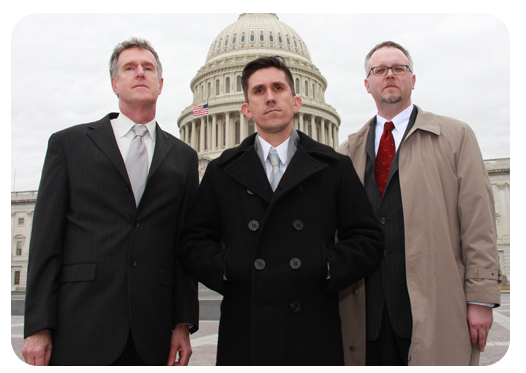 L to R: Jim Burling, Paul Beard II, and Brian Hodges | |
Here in the Northwest, we are all-too-familiar with this kind of government shakedown. We have seen cities demand that landowners pay hundreds of thousands of dollars to provide new roads, drains, parks and other public benefits that have no relationship to proposed projects in order to secure permit approvals. The reason this scheme is so popular is simple: because a person has to secure government approval before he or she can make any lawful use of land, the government sees a permit application as a prime opportunity to get something for nothing.
PLF argued to the Supreme Court that the same constitutional principles that limit the government's authority to take land from permit applicants should apply when the government demands cash. After all, both are property and both are protected by the Takings Clause of the Fifth Amendment.
The issues raised in Koontz have exposed a sharp divide between those who believe that private property must be protected against government intrusions and those who believe that government must be given all of the authority necessary to achieve its goals. Those divisions were on display during the argument and in the briefs submitted to the Supreme Court (for example, we received a brief arguing that cash demands are essential to fund local government needs that was signed by several attorneys general, including those from Washington, Oregon, and California).
In the days leading up to and following the Koontz argument, PLF attorneys wrote a series of articles discussing the various aspects of the case on the PLF Liberty Blog that are well worth a read.
PLF should receive a ruling in Koontz by the end of June.
Read more on the PLF case if you have time.
If you look through the Fenton appeal decision, you'll find a long part that describes that Fenton met the hydrogeologist (Neugebauer) at a property rights event. At the hearing, the county attorney took pains to characterize the scientist's passion for truth and his respect for property rights as if those were flaws. The Hearing Examiner included all that, at length. Why would a passion for science and respect for rights discredit a truly qualified expert witness?
Reflect that in 1955 quite a few in government didn't care one bit for people who dared to challenge institutions to stand for their rights. Left, right or undeclared - think about it. What are rights about, and should they be burdened and frustrated by domineering bullies in power? Remember Charles Dalton's story? Government should defend rights, not diminish them.
WE're glad that the Supreme Court is willing to take overreach and property rights seriously. Rights aren't arbitrary. They're personal.
PLF argued to the Supreme Court that the same constitutional principles that limit the government's authority to take land from permit applicants should apply when the government demands cash. After all, both are property and both are protected by the Takings Clause of the Fifth Amendment.
The issues raised in Koontz have exposed a sharp divide between those who believe that private property must be protected against government intrusions and those who believe that government must be given all of the authority necessary to achieve its goals. Those divisions were on display during the argument and in the briefs submitted to the Supreme Court (for example, we received a brief arguing that cash demands are essential to fund local government needs that was signed by several attorneys general, including those from Washington, Oregon, and California).
In the days leading up to and following the Koontz argument, PLF attorneys wrote a series of articles discussing the various aspects of the case on the PLF Liberty Blog that are well worth a read.
PLF should receive a ruling in Koontz by the end of June.
Read more on the PLF case if you have time.
If you look through the Fenton appeal decision, you'll find a long part that describes that Fenton met the hydrogeologist (Neugebauer) at a property rights event. At the hearing, the county attorney took pains to characterize the scientist's passion for truth and his respect for property rights as if those were flaws. The Hearing Examiner included all that, at length. Why would a passion for science and respect for rights discredit a truly qualified expert witness?
Reflect that in 1955 quite a few in government didn't care one bit for people who dared to challenge institutions to stand for their rights. Left, right or undeclared - think about it. What are rights about, and should they be burdened and frustrated by domineering bullies in power? Remember Charles Dalton's story? Government should defend rights, not diminish them.
WE're glad that the Supreme Court is willing to take overreach and property rights seriously. Rights aren't arbitrary. They're personal.

 RSS Feed
